A scenic road trip to Ineia and the Laona plateau, Cyprus

Few journeys in Cyprus combine spectacular landscapes, traditional villages, fascinating geology and centuries of history as beautifully as the drive through Ineia and the Laona Plateau. Overlooking the rugged coastline of the Akamas Peninsula, this scenic route offers visitors an authentic experience of rural Cyprus, where vineyards, ancient pathways, dramatic rock formations and timeless traditions coexist.
Whether you are interested in nature, photography, geology, birdwatching or simply discovering one of Cyprus’ most picturesque regions, the Laona Plateau is a destination worth exploring.
Where is the Laona Plateau?
The Laona Plateau occupies the northwestern part of the Pafos District and consists of a group of traditional villages, including Kathikas, Pano Arodes, Kato Arodes, Ineia, Drouseia, Kritou Tera, Androlykou and Fasli.
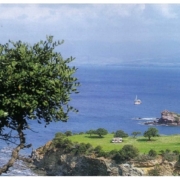
Its location creates one of the island’s most impressive landscapes. To the northwest lies the protected Akamas Peninsula, while the Chrysochous coastal plain stretches to the north. To the east, fertile valleys descend towards Polis Chrysochous, and to the southwest the landscape gradually opens towards the coastal plain of Pafos.
Following an ancient ridge road
The road linking Kathikas, Arodes, Ineia and Drouseia follows an elevated ridge that has served as a communication route for centuries.
Historical evidence suggests that parts of this route were already in use during Roman times. Archaeological and historical studies, including those documented by Jane Fejfer in Ancient Akamas, identify this ridge road as one of the principal routes connecting settlements across the Akamas region.
Today, the winding asphalt road allows visitors to enjoy panoramic views in every direction while travelling through one of the island’s most beautiful rural landscapes.
A landscape shaped by agriculture
Driving across the plateau reveals a landscape that has been cultivated for generations.
Vineyards cover many of the gentle slopes, while almond trees, olive groves, carob trees and seasonal crops form a colorful mosaic throughout the year. Between cultivated fields, natural mediterranean vegetation survives almost untouched.
Large terebinth trees, many of them centuries old, continue to provide shelter for numerous bird species, including both resident and migratory birds that use the Akamas Peninsula as an important migration corridor.
Cyprus traditional villages with timeless character
Despite gradual development and the growth of agrotourism, the villages of Laona have managed to preserve much of their traditional character.
Stone-built houses, arched doorways, timber roofs and enclosed courtyards still reflect the area’s architectural heritage. Seasonal customs continue to form part of village life, including the grape harvest, the preparation of traditional sweets such as palouze and soutzoukos, Easter celebrations and the pastoral traditions that have shaped the region for centuries.
Sheep and goats are still commonly seen grazing on the surrounding hillsides, reinforcing the authentic rural atmosphere that distinguishes Laona from many other parts of Cyprus.
A Geological treasure
The Laona plateau is equally remarkable from a geological perspective. Its landscape has been sculpted by erosion over millions of years, producing an intricate network of valleys, hills, steep slopes and seasonal streams.
The geology is exceptionally diverse and includes limestone, sandstone, chalk, marl, serpentinite, volcanic rocks and formations belonging to the Mamonia Complex. This extraordinary geodiversity makes the region one of the most interesting natural laboratories in Cyprus.
Vouni of Ineia – The highest point of Laona plateau
Although many locations across the plateau enjoy wide panoramic views, the finest viewpoint is undoubtedly Vouni of Ineia, also known as Vouni of Agios Georgios.
Rising to approximately 668 metres above sea level, it is the highest point on the Laona plateau. At its summit stands the small chapel of Agios Georgios, offering uninterrupted views across the peninsula, the surrounding villages, Chrysochous Bay and the western coastline of Cyprus.
The hill itself is formed by deep marine sediments, including radiolarites and quartz-rich sandstones, providing valuable evidence of the island’s complex geological history.
The spectacular quartz sandstone cliffs
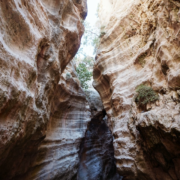
The eponymous geomorphologies of Ineia are particularly imposing in the landscape and are surrounded by wild vegetation as well as rich bird and reptile fauna. These rocks, as well as the rest of the rocks of the Vouni hill, are quartz sandstones and have the same composition and age, that is, between 210-95 million years.
These towering cliffs provide nesting sites for a variety of bird species and create one of the most dramatic landscapes in western Cyprus. Historically, the cliffs were home to colonies of vultures, which unfortunately have almost disappeared from the region. Today the area supports a variety of other birds, including jackdaws, rock doves, kestrels, peregrine falcons and barn owls.
These formations are a major destination for professional and amateur rock climbers.
A landscape rich in History
The strategic position of Ineia has attracted attention for centuries.
In his 1918 publication A Description of the Historic Monuments of Cyprus, George Jeffery suggested that the hill above the village may once have hosted a sixteenth-century observation point because of its commanding views over the coastline.
Historical cartography provides further evidence of the settlement’s importance. Maps published by Abraham Ortelius in 1573 and Vincenzo Maria Coronelli in 1689 identify the settlement as Igna -today’s Ineia- and include references to an observation point overlooking the surrounding coast. These early maps also record a settlement named Ara, which is generally associated with the present-day Lara area.
If you’re planning to explore the Laona plateau, Ineia and the surrounding villages, a detailed Cyprus Road Map can help you plan your route and discover nearby places of interest.
Why visit Ineia?
A journey through Ineia and the Laona plateau is far more than a scenic drive.
Visitors can combine spectacular viewpoints with traditional villages, geological landmarks, historic routes, birdwatching opportunities and authentic cypriot hospitality. The region offers an excellent introduction to the natural and cultural heritage of the Akamas peninsula while remaining one of western Cyprus’ most rewarding destinations.
Whether you spend a few hours exploring the villages or devote an entire day to discovering the plateau, the journey reveals a side of Cyprus where landscape, history and tradition continue to exist in remarkable harmony.
This article is based on the guide Exploring Ineia and the Beaches of Lara.
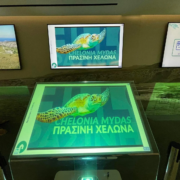
The guide is available at the Ineia–Lara Turtle Museum and Educational Centre.
SELAS contributed to the publication by providing geographical, historical and cartographic documentation, producing maps, and developing the official website for Ineia village. The company also provided services for the creation of the Inνia–Lara Turtle Museum and Educational Centre, supporting the preservation and promotion of the area’s rich cultural and geographical heritage. Learn more about the project on the SELAS website.
Learn more about the Ineia-Lara Turtle Museum project.
Visit the official Ineia-Akamas website for more information about Ineia and the beaches of Lara.
Planning your own Cyprus road trip?
Explore the SELAS range of detailed road and tourist maps of Cyprus.